
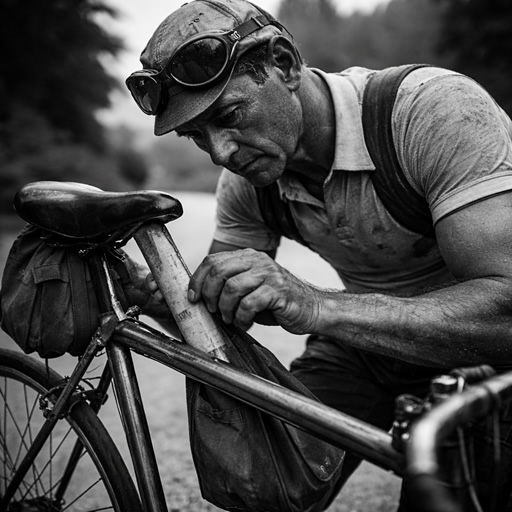
They waved him through the checkpoint and asked for his autograph.
He was a national hero, a celebrity athlete whose face was recognized everywhere. Even in wartime, people knew who he was. Guards smiled when they saw him. Soldiers cheered as he pedaled past.
To them, he was just training.
That was the explanation he always gave. Training. Long rides through the hills. Grueling climbs. Endless miles. It made sense. Champions had to stay sharp, even during war.
What they didn’t know was why he was really riding.
Hidden inside the hollow metal tubes of his bicycle frame and handlebars were forged identity papers—documents that would determine whether entire families lived or died. Every time he mounted the bike, he carried names, photographs, and false records that would allow Jewish families to escape deportation.
If he had been searched, he would have been executed on the spot.
But no one searched him.
They saw a famous cyclist.
They saw a national symbol.
They saw what they expected to see.
So he rode.
City to city.
Checkpoint to checkpoint.
Day after day.
He never told anyone what he was doing. Not teammates. Not fans. Not the press. He didn’t consider it heroic. He didn’t even consider it optional. To him, it was simply what needed to be done.
He wasn’t riding for medals anymore.
He wasn’t riding for recognition.
He was riding for lives.
Years later, long after the war had ended, someone finally asked him why he never spoke about it. Why he never claimed credit for saving hundreds of people.
He replied quietly, “That which is earned by doing good deeds is attached to the soul and shines elsewhere.”
This man was Gino Bartali, a two-time Tour de France champion and one of the greatest cyclists in history. While the world celebrated his athletic achievements, his true legacy was built in silence, on roads where no cameras followed.
Bartali’s story reveals something essential about purpose and identity.
Most people define themselves by roles, titles, or external success. Athlete. Leader. Executive. Parent. Expert. But under pressure, those labels mean very little. What matters is who you believe you are when no one is watching.
Bartali could have said, “I’m just a cyclist.”
He could have said, “This isn’t my responsibility.”
He could have said, “It’s too dangerous.”
Instead, his identity was anchored somewhere deeper. He didn’t act because he felt brave. He acted because, in his mind, there was no other option that aligned with who he was.
That’s the difference between having a purpose and being driven by it.
Purpose isn’t a slogan.
It isn’t something you talk about.
It’s something that quietly dictates your decisions when comfort, safety, and recognition are removed.
In everyday life, this shows up more often than we realize.
When pressure mounts, people reveal what they truly value. Some protect their image. Some protect their position. Others protect what matters, even if it costs them.
Purpose answers the question before it’s ever asked.
Identity removes the need for debate.
Bartali didn’t need external validation because his actions were aligned internally. That alignment gave him clarity. And clarity gave him courage.
Being intentional isn’t about dramatic moments. It’s about deciding, long before the moment arrives, what kind of person you are going to be.
Because when the stakes are high and the risks are real, you won’t rise to the level of your talent. You’ll act according to your identity.
Bartali understood that his greatest victories would never be recorded in history books. And he was perfectly at peace with that.
Which leads to a simple but uncomfortable question:
If no one ever knew what you did…
If there was no applause, no recognition, no reward…
Would your actions still reflect who you say you are?