
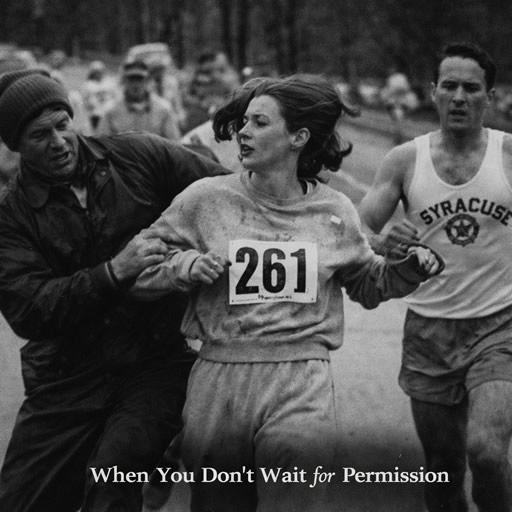
They tried to pull her off the course.
The race had already started.
Thousands of runners moved through the streets, but one participant drew attention immediately. Not because she was unprepared. Not because she was out of place.
But because she was a woman.
In 1967, the Boston Marathon did not officially allow female runners. It wasn’t written in bold prohibition. It was simply assumed. Women were told they weren’t capable. That distance would harm them. That endurance belonged to men.
She registered using her initials.
She trained seriously.
She qualified legitimately.
She showed up ready.
A few miles into the race, an official spotted her. Furious, he ran onto the course and grabbed at her bib number, shouting for her to get out.
Photographers captured the moment—an angry man lunging forward, trying to tear her from the race.
She didn’t stop.
Her teammates shielded her. They pushed the official away. She kept running.
Not to prove a point.
Not to make history.
Simply to finish what she had started.
Her name was Kathrine Switzer.
She became the first woman to officially run the Boston Marathon. She finished the race that day—not because the system welcomed her, but because she refused to let the system define her.
Her story reveals something powerful about identity.
Conviction does not wait for permission.
Most people look for external validation before stepping forward. They wait for policy to change. For consensus to form. For resistance to fade.
Switzer did not ask for approval.
She asked a simpler question: Am I capable?
The answer was yes.
So she ran.
Resistance showed up immediately. Publicly. Aggressively. She could have stepped off the course to avoid confrontation. She could have retreated and tried again another year.
Instead, she continued.
Conviction is not loud. It is steady.
It is the ability to maintain direction when pressure attempts to redirect you.
Switzer later explained that once the official tried to remove her, quitting was no longer an option. If she stopped, it would reinforce the narrative that women did not belong there. Finishing the race became bigger than her personal goal.
This is how identity evolves into leadership.
When your decision stops being about comfort—and becomes about what you represent—conviction deepens.
In organizations, similar moments appear.
Someone challenges outdated assumptions. They present new ideas in rooms resistant to change. They step into spaces historically closed to them.
Resistance often shows up quickly.
Dismissal.
Ridicule.
Institutional inertia.
The question becomes: Do you withdraw—or continue?
Being intentional means deciding who you are before the resistance arrives.
Switzer didn’t wait for the marathon to change its rules before she ran. Her action helped change the rules.
That’s the paradox of courage.
You don’t wait for doors to open.
Sometimes you run anyway.
Kathrine Switzer didn’t set out to become a symbol. She set out to finish a race.
But finishing mattered.
Because sometimes progress begins not with protest—but with persistence.
Which leads to a question worth considering:
When the system implies you don’t belong,
Do you wait for permission…
Or do you step forward and run?