
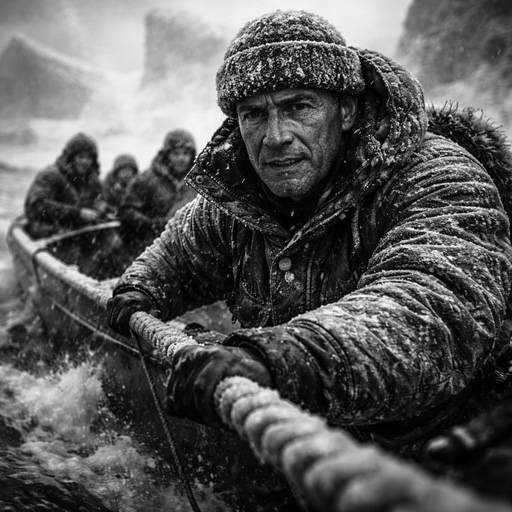
By every traditional measure, the mission was a failure.
The ship never reached its destination.
The maps were never completed.
The continent was never crossed.
Instead, the ice closed in.
The wooden ship groaned under pressure it was never designed to withstand. Slowly, relentlessly, it was crushed by ten million tons of ice. What had once been a symbol of ambition became splintered wreckage trapped in a frozen sea.
No radio.
No rescue plan.
No margin for error.
Twenty-eight men stood on the ice, thousands of miles from civilization, watching their ship disappear.
At that moment, the mission changed.
What had begun as an expedition of exploration became a fight for survival. And everything depended on whether the man in charge understood that reality quickly enough.
For months, they camped on drifting ice floes. When the ice broke apart, they lived under overturned lifeboats. They hunted seals and penguins for food. They endured darkness, isolation, and crushing uncertainty.
What mattered most wasn’t strength.
It wasn’t intelligence.
It wasn’t even courage.
It was leadership.
The man leading them understood something critical: when circumstances change, clinging to the original plan can become deadly. So he abandoned the goal without abandoning the people.
He gave his own rations to the sick.
He rotated sleeping arrangements to prevent isolation.
He required social time to protect morale.
He watched the emotional state of his men as closely as their physical condition.
When the ice finally released them, he made the most dangerous decision of all. He selected a small crew, climbed into a lifeboat barely fit for survival, and sailed 800 miles across the most violent ocean on Earth to find help.
Against all odds, he succeeded.
Every single man survived.
This man was Sir Ernest Shackleton, leader of the Endurance expedition. He failed to achieve the original objective—but succeeded at something far more important. He brought his entire team home alive.
Shackleton’s story exposes a hard truth about leadership.
Most people believe leadership is about sticking to the plan at all costs. About persistence. About refusing to quit. But true leadership isn’t stubborn—it’s responsive.
Adaptive leadership recognizes when the definition of success must change.
The goal is important.
The vision matters.
But people matter more.
When leaders cling to outdated objectives, they stop serving the mission and start serving their ego. They confuse persistence with rigidity. They mistake consistency for competence.
Shackleton didn’t do that.
The moment survival became the real mission, he adjusted everything—priorities, expectations, daily structure, and decision-making. He didn’t lament what was lost. He focused on what was required now.
This principle shows up everywhere.
In business, leaders often push teams toward goals that no longer fit reality. Markets shift. Conditions change. Resources disappear. And instead of adapting, leaders double down, hoping effort will compensate for misalignment.
In life, people do the same thing. They chase plans that made sense years ago but no longer serve who they’ve become. They hold onto identities, timelines, and expectations long after the environment has changed.
Being intentional means recognizing when adaptation is not failure—but wisdom.
It means asking a different question:
Not “How do we force this plan to work?”
But “What does leadership require now?”
Shackleton never lost sight of responsibility. His authority didn’t come from command—it came from care. His men trusted him because every decision made one thing clear: their lives mattered more than his reputation.
That’s adaptive leadership.
It doesn’t cling.
It doesn’t panic.
It adjusts without losing integrity.
Shackleton didn’t conquer a continent. But he did something far rarer.
He led people through uncertainty and brought them home.
Which leaves a question worth considering:
When conditions change and the plan no longer fits reality,
Do you cling to the goal to protect your pride…
Or do you adapt to protect your people?