
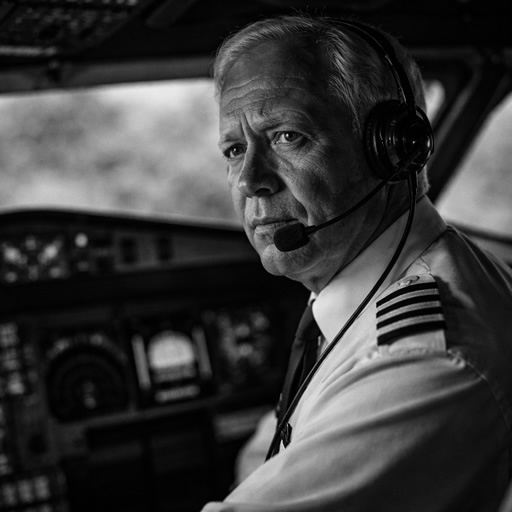
The engines failed at 2,800 feet.
There was no warning.
One moment, the plane was climbing out of New York. The next, both engines were gone—disabled by a flock of geese. The cockpit filled with alarms. The aircraft lost power. The city waited below.
Passengers didn’t know yet.
But in the cockpit, there were seconds to decide.
Return to LaGuardia?
Attempt Teterboro?
Or do something no one had ever done before?
There was no checklist titled “Dual engine failure over Manhattan.”
There was no margin for debate.
Only discipline.
The captain did not panic. He did not rush. He did not guess.
He evaluated altitude, glide ratio, distance, and wind. He ignored noise. He focused on math. He focused on physics. He focused on what was real.
Then he said four words that would define the moment:
“We’re going to the Hudson.”
Captain Chesley “Sully” Sullenberger had spent decades preparing for a situation he hoped would never happen. Thousands of flight hours. Simulations. Military training. Risk assessment. Repetition.
The public would later call it a miracle.
He called it training.
He angled the powerless Airbus A320 toward the Hudson River and executed a near-perfect water landing. All 155 people on board survived.
But what makes this story powerful isn’t the landing.
It’s the preparation before it.
Crisis doesn’t create skill. It reveals it.
When time disappears, training takes over. When emotion rises, discipline steadies the hand. When pressure builds, preparation narrows focus to what matters.
Most people assume they will “figure it out” when the moment comes.
They won’t.
They will default to the level of their preparation.
Sullenberger later explained that during the emergency, he was not thinking about heroics. He was running mental models. Evaluating scenarios. Applying learned patterns automatically.
That automatic response wasn’t luck.
It was earned.
This principle reaches beyond aviation.
In business, leaders often wait until crisis strikes to build systems. They postpone training. They ignore contingency planning. They assume experience alone will carry them through.
Then pressure hits—and reaction replaces intention.
In life, people do the same thing. They avoid hard conversations until relationships fracture. They ignore health until symptoms escalate. They neglect planning until options narrow.
Preparation feels unnecessary—until it’s essential.
Sullenberger didn’t rise to the level of the emergency.
He fell to the level of his training.
That distinction matters.
Predictable process produces predictable results.
The Hudson landing was not random. It was the product of repetition, discipline, and mental clarity built long before anyone needed it.
Being intentional means preparing when there is no urgency.
It means building capacity when things are calm.
It means understanding that the moment you hope never comes is exactly the moment your preparation will be tested.
After the landing, Sullenberger walked the cabin twice to ensure every passenger was off the plane before he left. Calm. Methodical. Responsible.
Leadership doesn’t start in crisis.
It’s revealed there.
Which leads to a question worth asking:
When your engines fail—figuratively or literally—
Will you rely on instinct and hope…
Or on preparation you built before the moment arrived?