
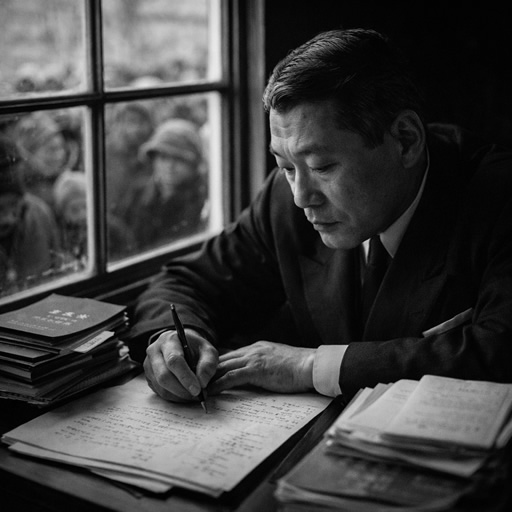
He kept writing long after he was told to stop.
The orders were clear.
Close the consulate.
Stop issuing visas.
Return home immediately.
The cables from his government grew more direct each time. His superiors had decided. The paperwork would cease. The responsibility would end.
But outside his office window, the line kept growing.
Families stood in the cold for hours. Parents clutched documents with trembling hands. Children waited quietly, sensing something was wrong but not understanding what.
They weren’t asking for favors.
They were asking for survival.
He knew the consequences of defying orders. He understood what it meant to disobey his government during wartime. His career would be over. His reputation could be damaged permanently.
Still, he kept writing.
Visa after visa.
Signature after signature.
Page after page.
When his hand cramped, he switched hands. When the consulate officially closed, he continued from his hotel room. When he was finally ordered to board a train and leave the country, he carried stacks of unsigned documents with him and continued signing from the window as the train pulled away.
He apologized to the families for not being able to do more.
His name was Chiune Sugihara.
He was a Japanese diplomat stationed in Lithuania during World War II. Against direct orders, he issued thousands of transit visas to Jewish refugees fleeing Nazi persecution. Those documents allowed families to escape through Japan and survive the war.
For years afterward, his actions were largely ignored. He lost his diplomatic career. He worked ordinary jobs. He never sought attention.
Decades later, historians would estimate that tens of thousands of people are alive today because of the visas he signed.
Sugihara’s story reveals something essential about vision.
Vision is not optimism.
It is not ambition.
It is not strategy.
Vision is the ability to see beyond immediate consequence.
Most people obey systems because systems feel safe. Compliance feels secure. Following instruction protects position.
But leadership grounded in responsibility sometimes requires stepping beyond instruction.
Sugihara understood that rules are designed to preserve order—but they are not always designed to preserve life.
The easy path was obedience.
The safe path was departure.
The expected path was silence.
He chose responsibility instead.
This principle reaches far beyond history.
In organizations, people hide behind policy when faced with moral complexity. “That’s not my role.” “Those are the guidelines.” “My hands are tied.”
Sometimes they are.
Sometimes they are not.
Being intentional means asking a harder question:
“What is actually mine to do here?”
Responsibility does not always align with authority. And vision often requires sacrifice long before recognition arrives.
Sugihara did not know how history would judge him. He did not know whether his decision would ultimately matter. He only knew that people were standing outside his door—and that he had the power to help them.
So he used it.
Not loudly.
Not defiantly.
Just persistently.
Leadership rooted in vision does not wait for perfect clarity. It acts when conscience and responsibility intersect.
Sugihara once said, “I may have to disobey my government, but if I don’t, I would be disobeying God.”
His decision cost him position.
It gave others a future.
Which leads to a question worth considering:
When instruction conflicts with responsibility,
Do you protect your role…
Or do you protect what matters?