
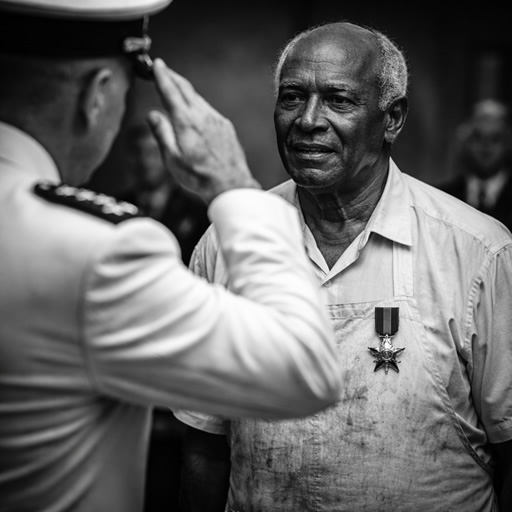
It was supposed to be a routine retirement ceremony.
A three-star Vice Admiral.
A packed room.
Polished uniforms and carefully planned remarks.
But when Vice Admiral Richard Bennett entered the room, he didn’t take his seat.
Instead, he stood beside an empty chair.
The staff waited.
The audience shifted uncomfortably.
Minutes passed in silence.
Finally, Bennett spoke.
He told the staff to find a man named Vincent Palmer.
No one recognized the name.
They eventually found him in the kitchen.
Vincent was seventy-nine years old, wearing a food service uniform and a white apron stained from a morning of work. He had spent the last fifteen years in the base cafeteria, serving meals to officers who passed by without a second glance.
When he was told the Admiral was looking for him, Vincent was terrified. He assumed he had done something wrong.
When he entered the room, every conversation stopped.
Vice Admiral Bennett snapped to attention and delivered a crisp salute.
The room gasped.
Then Bennett told the story.
More than fifty years earlier, during an ambush in Vietnam, a Marine Master Gunnery Sergeant named Vincent “Gunny” Palmer had tackled an enemy soldier and taken a bullet that would have killed a young officer.
That officer was Richard Bennett.
“You’re the reason I’m standing here,” Bennett said.
Vincent Palmer—quiet, unassuming, wearing a cafeteria apron—was the reason a three-star Admiral had lived long enough to reach that rank.
Bennett pinned a Silver Star directly onto Vincent’s apron and gave him the seat of honor.
Later, someone asked Vincent why a decorated Marine with decades of service would choose to spend his retirement serving mashed potatoes.
His answer was simple.
“I wanted peace,” he said. “After years of chaos, I needed something quiet. I could serve people. Make sure they had a good meal. That mattered to me.”
This story dismantles one of the most dangerous myths about leadership.
That leadership ends when the title is gone.
Vincent Palmer didn’t stop leading when he retired from the Marines. He simply led differently. He chose service without recognition. Contribution without authority. Purpose without applause.
True leadership doesn’t cling to rank.
It doesn’t demand visibility.
It doesn’t need validation.
It understands that responsibility outlives position.
Admiral Bennett later admitted his own discomfort. He had walked past Vincent in that cafeteria multiple times without realizing who he was—or what he had done. The shame wasn’t in not knowing. It was in assuming leadership only looked one way.
Rank is easy to spot.
Service requires attention.
This principle shows up everywhere.
In organizations, people confuse titles with influence and authority with leadership. They stop serving once the role changes. They disengage when recognition fades.
In life, the same thing happens. People believe their value is tied to status, productivity, or visibility. When those change, purpose feels lost.
But leadership rooted in responsibility doesn’t disappear—it adapts.
Vincent Palmer didn’t need medals to know who he was. He had already decided that leadership meant showing up, doing what mattered, and serving where he could.
After the ceremony, Bennett made sure Vincent’s story didn’t end there. He offered him a new role as a veterans liaison, helping young service members transition to civilian life. Vincent spent his final years doing what he had always done—serving others quietly, intentionally, and fully.
At Vincent’s funeral years later, Admiral Bennett said it plainly:
“Rank is responsibility, not privilege. True leaders never stop leading. They just lead differently.”
That leaves a question worth asking:
When recognition fades and titles change,
Do you stop leading…
Or do you keep serving where it still matters?