
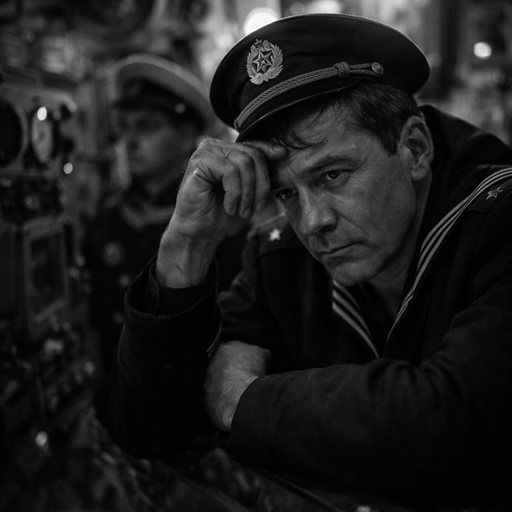
The submarine was suffocating.
The air was thick. The temperature was rising. Communication with Moscow had been cut off for days. Above them, American ships were dropping depth charges—signals meant to force them to surface.
Inside the Soviet submarine B-59, the crew believed war had already begun.
They were armed with a nuclear torpedo.
Protocol was clear. If they were under attack, they could respond.
But one launch required three officers to agree.
Two said yes.
One said no.
The year was 1962. The Cuban Missile Crisis had pushed the world to the edge. Tensions between the United States and the Soviet Union were at their highest point. Miscalculation could trigger global catastrophe.
On that submarine, isolated and under pressure, Captain Valentin Savitsky was convinced that war had started. The depth charges felt like aggression. The silence from Moscow felt like confirmation.
He ordered the nuclear torpedo prepared.
The political officer agreed.
Only one man stood in the way.
Vasili Arkhipov.
He was not the captain.
He was not in command of the vessel.
But his authorization was required.
Arkhipov believed the depth charges were signals, not attacks. He believed launching a nuclear weapon without confirmed orders would ignite a war neither side truly wanted.
Inside a steel hull, under crushing stress and heat, he argued.
He resisted escalation.
He insisted they surface instead.
For long, tense minutes, the decision hung in the balance.
Then Savitsky relented.
The submarine surfaced.
There was no war.
History continued.
Vasili Arkhipov never became famous for what he did that day. There were no medals pinned in front of crowds. No ceremonies. No headlines.
But his refusal may have prevented nuclear war.
This story reveals a different kind of courage.
Not the courage to act.
The courage to restrain.
In moments of extreme pressure, escalation feels powerful. It feels decisive. It feels like control. But leadership often requires the opposite impulse—the strength to slow down when everything pushes forward.
Arkhipov had no guarantee he was right. He had no certainty that restraint would protect them. But he understood something critical:
Reaction can trigger consequences that cannot be reversed.
Conscience is rarely loud. It doesn’t shout over alarms. It speaks quietly, often in opposition to authority, momentum, and fear.
And moral courage is not dramatic. It is steady.
Arkhipov did not raise his voice to dominate. He did not seize command. He simply refused to authorize something he believed would be catastrophic.
Leadership without authority is one of the purest forms of leadership.
It doesn’t rely on rank.
It doesn’t rely on recognition.
It relies on responsibility.
This principle shows up everywhere.
In organizations, groupthink builds quickly. Pressure narrows perspective. When everyone leans one direction, it becomes dangerous to stand the other way. Silence feels safer. Agreement feels strategic.
But history rarely turns because of unanimous decisions. It turns because one person asks, “Are we sure?”
In life, escalation often happens in smaller ways. Arguments intensify. Emails grow sharper. Decisions compound emotionally instead of intentionally. The instinct is to respond quickly—to match force with force.
Restraint requires strength.
It requires clarity under pressure.
It requires the willingness to be the lone dissenting voice when stakes are high.
Vasili Arkhipov did not launch a torpedo.
He simply said no.
And sometimes, that is the most powerful act of leadership available.
Which raises a difficult question:
When momentum pushes toward escalation and everyone around you agrees,
Do you move with the crowd…
Or do you have the courage to be the third vote?