
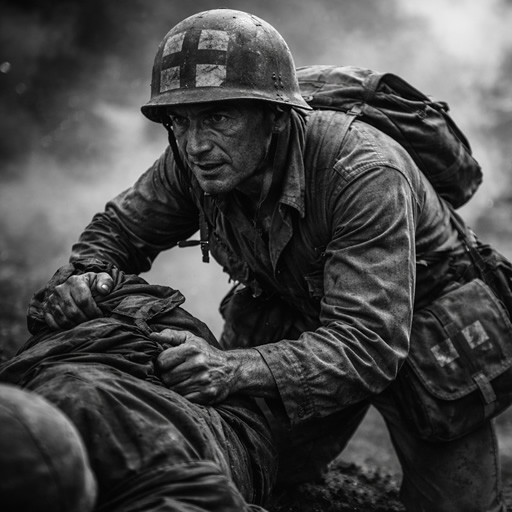
They called him a coward before the war even started.
During basic training, the insults came daily. They threw shoes at him while he prayed. They mocked him relentlessly and tried to have him discharged for being mentally unfit.
All because he refused to carry a rifle.
He wasn’t a pacifist because he was afraid of combat. He volunteered for the army knowing exactly where he was going. He simply believed his role was to save life, not take it. He trained as a medic and held fast to his conviction, even when it made him a target within his own unit.
To them, courage meant carrying a weapon.
To him, courage meant standing firm.
Then came Okinawa.
The ridge was sheer rock, later nicknamed Hacksaw Ridge. The climb was brutal. The enemy fire was relentless. When the order to retreat was given, the rest of the division pulled back, leaving the wounded behind. Anyone still up there was assumed dead.
But he didn’t retreat.
Alone on the ridge, with no weapon and no protection, he ran back into the smoke. Under constant machine-gun fire, he found a wounded soldier, dragged him to the edge of the cliff, and lowered him to safety.
Then he went back.
And again.
And again.
For twelve hours, he moved through chaos and blood, carrying, dragging, lowering one wounded man at a time. Each time he whispered the same prayer: “Lord, help me get one more.”
When he could no longer see clearly.
When his hands were raw.
When exhaustion should have stopped him.
He didn’t stop.
By the time the night ended, seventy-five men were alive who would not have been otherwise.
This man was Desmond Doss.
The same man his unit once tried to get rid of became the reason many of them went home. He became the first conscientious objector to receive the Medal of Honor—not because he broke his convictions, but because he lived them under fire.
There’s a powerful distinction in this story that’s easy to miss.
Desmond Doss didn’t suddenly find courage on that ridge. He didn’t “rise to the occasion.” His courage was already decided long before the bullets started flying. What happened on Hacksaw Ridge wasn’t a transformation—it was a revelation.
Conviction works that way.
Most people believe courage is a feeling. Something that shows up when the moment demands it. But real courage isn’t emotional. It’s directional. It comes from clarity—knowing what you stand for so clearly that pressure doesn’t create confusion.
Doss had already answered the hard questions.
What do I believe?
What am I responsible for?
What will I not compromise?
So when everyone else retreated, there was no debate inside him. His actions flowed naturally from his convictions.
This applies far beyond the battlefield.
In leadership, people often abandon their values under pressure. Not because they’re bad people—but because they never defined their convictions clearly enough to withstand resistance. When approval, comfort, or safety are threatened, conviction collapses into convenience.
Being intentional means deciding your convictions before they’re tested.
It means understanding that courage doesn’t always look aggressive or loud. Sometimes it looks like standing alone. Sometimes it looks like being misunderstood. Sometimes it looks like refusing to become someone you’re not—even when everyone around you expects it.
Desmond Doss didn’t prove his strength by carrying a weapon. He proved it by carrying others.
And in doing so, he redefined what courage actually looks like.
Which leaves a question worth sitting with:
When pressure mounts and resistance shows up,
Do you abandon your convictions to survive the moment…
Or do your convictions carry you through it?