
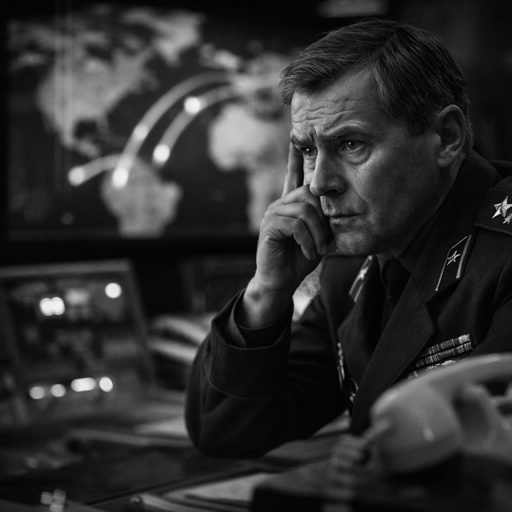
He stared at the screen and waited for confirmation.
The alarm was unmistakable.
Missiles had been launched.
Five of them.
The early-warning system was clear. The protocol was clear. His responsibility was clear. Report the attack immediately so retaliation could begin.
He had minutes.
Inside the bunker, tension thickened. Officers moved quickly. Phones waited to ring. If he confirmed the alert, the response chain would activate. If the response chain activated, nuclear war would begin.
Everything in his training told him to follow procedure.
Instead, he did something unexpected.
He paused.
The system said the United States had launched five nuclear missiles toward the Soviet Union. But something didn’t feel right. Why only five? Why not hundreds? An actual first strike would aim to eliminate, not provoke.
He reviewed the data again.
The satellites showed launches. The computers confirmed them. The warning lights flashed insistently.
He chose not to report it.
He told his superiors the system was wrong.
He bet the world on that decision.
For long, silent minutes, they waited.
No missiles struck. No explosions followed. The alert had been triggered by sunlight reflecting off clouds—an error in a new satellite system.
The man on duty that night was Stanislav Petrov.
He was not a general.
He was not a head of state.
He did not have political power.
But on September 26, 1983, he made a decision that likely prevented nuclear war.
What makes this story powerful isn’t luck.
It’s restraint.
Petrov was trained to trust the system. Procedure existed for a reason. But training without judgment becomes dangerous. Systems are built by humans, and humans build imperfect things.
In high-pressure moments, reaction feels safer than thought.
Procedure feels safer than responsibility.
But leadership requires something more than obedience. It requires discernment.
Petrov didn’t ignore his training. He used it. He understood strategic doctrine well enough to recognize that five missiles didn’t align with expected behavior. He controlled his fear long enough to ask a better question.
“What makes sense here?”
That pause changed everything.
This principle reaches far beyond Cold War bunkers.
In business, automated dashboards flash warnings. Metrics dip. Competitors move. The instinct is to react immediately—cut costs, fire people, pivot wildly.
In life, criticism triggers defense. Stress triggers escalation. Conflict triggers retaliation.
Reaction is fast.
Reaction feels decisive.
Reaction often escalates the problem.
Intentional response requires space.
It requires the discipline to pause when everything in the room demands speed.
Preparation is not just skill—it is mental steadiness. It is understanding patterns deeply enough to recognize when something doesn’t fit.
Petrov later said he had a “funny feeling in his gut.” But that instinct wasn’t random. It was built from years of understanding how systems worked—and how they failed.
When pressure rises, the question is rarely, “Do you know the procedure?”
The real question is:
“Can you think clearly when procedure says act?”
Stanislav Petrov went home the next morning and told almost no one what had happened. For years, his decision remained largely unknown.
But the world continued.
Which leads to a question worth asking:
When alarms go off—externally or internally—
Do you react because the signal is loud…
Or do you pause long enough to decide what’s actually true?