
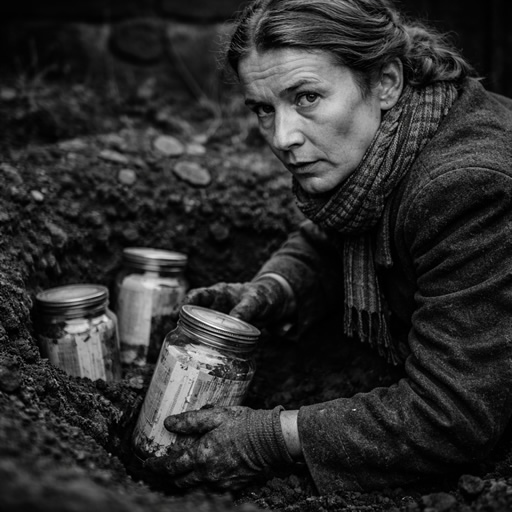
She walked past the guards carrying a toolbox.
They barely looked at her. She had papers that allowed her to enter. A social worker, authorized to check for typhus outbreaks inside a restricted zone. Someone useful. Someone unthreatening.
What they didn’t see was the baby hidden inside the toolbox.
They didn’t see the children concealed beneath the floorboards of her ambulance. They didn’t see the toddlers tucked into potato sacks. And they never imagined what she was really doing once she passed through the gates.
Inside the walls, despair was everywhere. Families were disappearing. Children were being separated from their parents, loaded onto trains, and erased from the future.
She couldn’t stop it.
But she could interrupt it.
One child at a time.
Each rescue carried the same risk. If discovered, she would be executed immediately. Not imprisoned. Not questioned. Executed.
Still, she returned. Again and again.
Saving the children wasn’t enough for her. She understood something others overlooked—rescue without remembrance is incomplete. So she wrote their real names and their new false identities on thin strips of paper. She rolled them up, sealed them in glass jars, and buried them beneath an apple tree in a neighbor’s yard.
She was preserving more than lives.
She was preserving identity.
She was protecting a future she might never see.
Eventually, the inevitable happened.
She was arrested.
Her captors broke her legs and tortured her relentlessly. They demanded names. Networks. Locations. She gave them nothing.
Not one child.
Not one family.
Not one jar.
She survived the war, though many years passed before her story was widely known. When recognition finally came, she brushed it aside. “I only did what anyone should do,” she said.
Her name was Irena Sendler.
She helped save 2,500 children from the Warsaw Ghetto.
Her story forces us to confront a difficult truth.
Sacrifice is rarely dramatic in the moment. It’s quiet. Repetitive. Often unseen. It requires choosing responsibility over safety, and purpose over comfort—again and again—without knowing whether it will matter in the end.
Irena Sendler didn’t know if the war would end. She didn’t know if the jars would ever be recovered. She didn’t know if the children would survive long enough to reclaim their names.
She acted anyway.
That’s vision.
Vision isn’t optimism. It isn’t confidence that things will work out. It’s a commitment to act in alignment with what matters, even when outcomes are uncertain.
Most people hesitate because they want guarantees. They want assurance that their sacrifice will be worth it, that it will be recognized, that it will succeed.
But leadership rooted in vision doesn’t wait for certainty. It accepts risk as the price of responsibility.
This principle shows up far beyond history.
In leadership, sacrifice often means making decisions that won’t benefit you directly. It means absorbing discomfort so others don’t have to. It means protecting what matters long before anyone understands why.
In life, vision asks something similar. It asks you to think beyond the present moment. Beyond convenience. Beyond fear. It asks you to invest in a future you may never personally benefit from.
That kind of vision changes everything.
Irena Sendler didn’t see herself as heroic. She saw herself as responsible. And responsibility, when taken seriously, has a way of reshaping history.
She once said, “You see a person drowning, you must try to save them, even if you cannot swim.”
There’s no strategy in that statement.
No guarantee.
No applause.
Only conviction that doing nothing was not an option.
Which brings us to a question worth sitting with:
When the cost is high and the outcome uncertain,
Do you protect your comfort…
Or do you invest in a future that depends on your courage?