
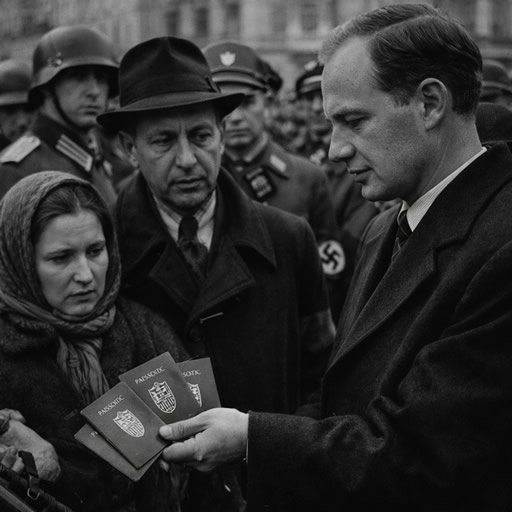
They called them “protective passports.”
The documents weren’t fully legal.
They weren’t fully recognized.
They weren’t even fully authorized.
But they worked.
He printed them by the thousands—documents declaring that the bearer was under the protection of a neutral nation. He hung flags over buildings and declared them sovereign ground. He negotiated, threatened, persuaded, and improvised.
He was a diplomat.
But diplomacy had long since failed.
Budapest, 1944. Deportations were accelerating. Trains were leaving daily. Entire families were being erased with bureaucratic efficiency.
He arrived with authority limited by paperwork.
He operated with authority rooted in responsibility.
Every day, he stood at train stations pulling people from deportation lines, placing documents in shaking hands, insisting they were protected. Sometimes guards argued. Sometimes they relented. Sometimes they didn’t.
He took risks that went far beyond policy.
He rented dozens of buildings and labeled them safe houses. He moved constantly. He negotiated directly with officials who had little reason to cooperate.
He did not have an army.
He did not have enforcement power.
He had credibility—and courage.
His name was Raoul Wallenberg.
A Swedish diplomat stationed in Hungary during World War II, Wallenberg is credited with saving tens of thousands of Jewish lives through creative intervention and relentless presence.
What makes his story powerful isn’t just bravery.
It’s ingenuity under moral pressure.
When systems fail, people often default to despair or compliance. “There’s nothing I can do.” “It’s bigger than me.” “The structure is fixed.”
Wallenberg refused that frame.
He understood something critical:
Authority is not the same as impact.
He used the tools available—paper, symbols, negotiation—and expanded them beyond their intended limits. He blurred lines between official and unofficial because the moment demanded it.
This is leadership that operates beyond permission.
It does not wait for perfect clarity.
It asks: What leverage do I have?
Then it uses it.
Most people think standing alone requires loud resistance. Often, it requires persistent action within broken systems.
Wallenberg didn’t overthrow regimes. He didn’t give speeches to the masses. He operated tactically, strategically, relentlessly—one life at a time.
In organizations, similar moments appear.
Policies exist that quietly harm morale. Systems persist that no longer serve. Leaders claim limitations that are more cultural than structural.
The easy path is to operate strictly inside boundaries.
The harder path is to expand them.
Being intentional means recognizing when the rules are insufficient—and choosing responsibility anyway.
Wallenberg did not know the long-term outcome of his efforts. He did not know whether the buildings he labeled “protected” would remain safe. He acted within uncertainty.
After the war, he disappeared into Soviet custody and was never seen again. Recognition came later. Clarity came later.
But the lives saved remained.
Standing alone is rarely glamorous.
It is often administrative.
Often exhausting.
Often invisible.
But leadership measured by impact does not require applause.
It requires commitment.
Which raises the question:
When systems around you are failing people,
Do you operate comfortably within their limits…
Or do you expand what’s possible with the authority you already have?